In contemporary society, heightened awareness of mental health has propelled Psychology into one of the most highly sought-after fields of study. However, developing into an exceptional psychological professional requires more than a profound comprehension of abstract theoretical frameworks. Recognizing this imperative, the modern undergraduate curriculum in Psychology at Van Hien University has continuously undergone a strategic transformation, pivoting toward an applied and practice-oriented approach.
Instead of conventional, theory-dense lectures, Psychology students at Van Hien University engage in a highly pragmatic and rigorous training roadmap. This curriculum features a scientifically structured sequence of practical modules and internships spanning from their freshman year until graduation.
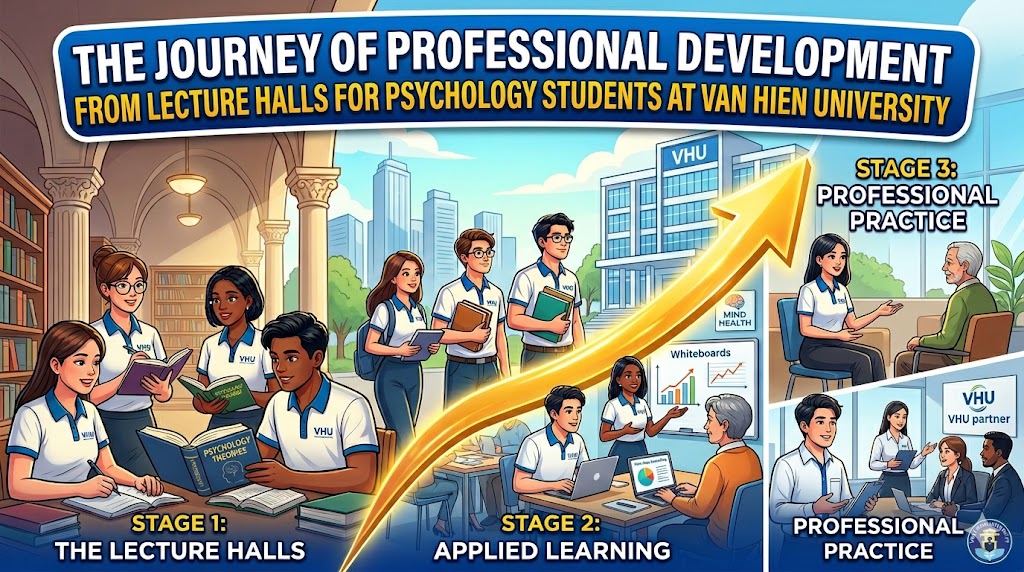
1. Commencing with the "Career Experience" Module
During the initial semesters, when psychological concepts remain relatively novel, students are introduced to the Career Experience module. This serves as a vital foundational stepping stone, enabling learners to deconstruct common misconceptions regarding the discipline.
In tandem with acquiring professional knowledge in the lecture hall, students engage in early-stage field trips and site visits across a diverse range of professional environments, including:
• Psychiatric hospitals and psychological clinics.
• Schools and specialized educational centers.
• Corporations, enterprises, and large conglomerates.
This module offers a comprehensive overview of the two primary specializations within the university's Psychology curriculum: Psychological Counseling and Therapy, and Psychological Counseling and Human Resource Management. Through these firsthand observations, students can discern their aptitudes early on, thereby formulating appropriate plans for advanced professional development.
2. Refining Skills through "Professional Practice" at host institutions
Upon acquiring a robust theoretical foundation, students transition beyond the traditional classroom setting into the Professional Practice module. The core attribute of this module is that students no longer merely engage in role-playing or hypothetical case studies within the classroom; instead, they are directly stationed at host organizations such as hospitals, psychological counseling centers, schools, non-governmental organizations (NGOs), or human resource departments within enterprises.
This experiential learning phase represents a significant milestone. Under the direct supervision and professional guidance of practitioners, psychologists, or institutional managers, students are entrusted with applied, real-world tasks. Depending on their chosen specialization, they actively participate in specific operational duties within corresponding organizations.
3. The cornerstone "Corporate semester" – immersive real-world experience
The most distinctive and innovative feature of the practice-oriented curriculum at Van Hien University is the Corporate Semester. During this period, students temporarily depart from academic lecture halls to integrate into partner enterprises and institutions. The modules within the Corporate Semester carry a substantial number of internship and practical credits, requiring students to directly apply their knowledge to actual workplace demands:
• For the Human Resources track: Students participate in recruitment processes, employee performance appraisals, internal communications, or corporate culture development within enterprises.
• For the Counseling/Therapy track: Students operate as assistants, supporting school psychologists or specialists in centers and hospitals with behavioral observation, client case-file documentation, and mental health education campaigns.
The Corporate Semester not only consolidates specialized expertise but also provides an invaluable opportunity for students to assimilate corporate culture, while cultivating teamwork, communication skills, and stress tolerance within a professional environment.
4. The ideal transition via the "Graduation internship"
The Graduation Internship represents the final phase and the most comprehensive challenge before students are officially awarded their bachelor's degree. Distinguishable from short-term field experiences, the graduation internship demands that students operate as actual entry-level professionals over an extended period of two to four months.
At their host institutions, students are expected to independently construct work plans, undertake specific professional responsibilities, and contribute tangible value to the organization. Under the mentorship of institutional supervisors and university faculty, students refine not only their technical competencies but also their professional ethics—a critical element in the field of Psychology. A significant number of students demonstrate exceptional performance during this phase, securing official employment offers from their host organizations prior to formal graduation.
Conclusion
The practice-oriented undergraduate curriculum in Psychology at Van Hien University represents a definitive paradigm shift, effectively bridging the gap between academic theory and the rigorous demands of the labor market. By systematically synthesizing scientific knowledge with career experiences, professional practice, corporate semesters, and graduation internships, the curriculum equips students with the essential competencies to confidently navigate their future career paths.
Graduates enter the profession not only with a robust academic foundation but also with advanced practical capabilities. They stand ready to contribute to, accompany, and serve as mental health facilitators for the community, driven by both professional expertise and profound empathy.
Written by: PhuHM